Mahjong
The mahjong table seen from the player's seat: a burgundy felt table with a walnut frame, tiles in the wall and discards in the middle, and your rack of ivory tiles in front.

Mahjong 麻將

A beautiful 3D mahjong game for the web, iOS, Android and Windows. Six variants, a tutorial for every one, and online multiplayer: share a table code and play with friends, as a guest with just a name.

Coming soon: web, iOS, Android, Windows See the variants

Play in your browser, on your phone or tablet, or on a PC.

  • 6playable variants
  • 38tutorial lessons
  • 3opponent levels
  • 3more variants coming
Playable now

Six ways to play

Each variant has its own rules, scoring and computer opponents, and its own tutorial.

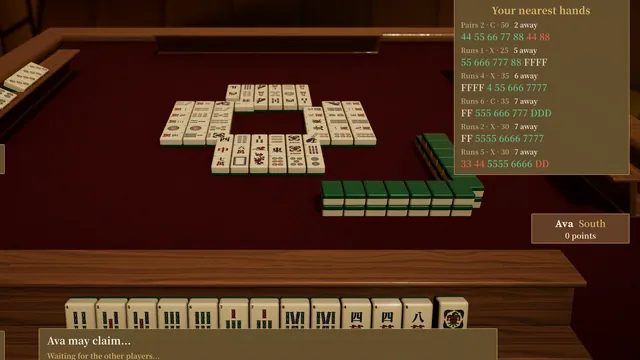
An American game in progress: the player's rack of tiles, a panel listing the nearest hands on the House Card, and tiles laid out at the center of the table.

American

  • House Card
  • Jokers
  • Charleston

Played with an original House Card written for the game. Pass tiles in the Charleston, chase the card's hands, and use jokers.

9 lessons

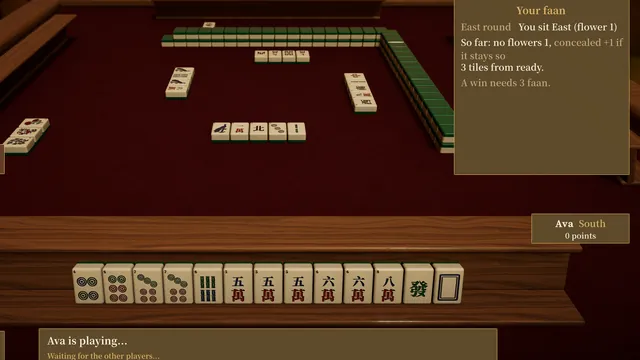
A Hong Kong hand: the player's rack with a panel showing the current faan count and how many tiles away a win is.

Hong Kong

  • Faan
  • 3 faan to win

Scored in faan. A side panel tracks your faan as the hand develops and how close you are to winning.

5 lessons
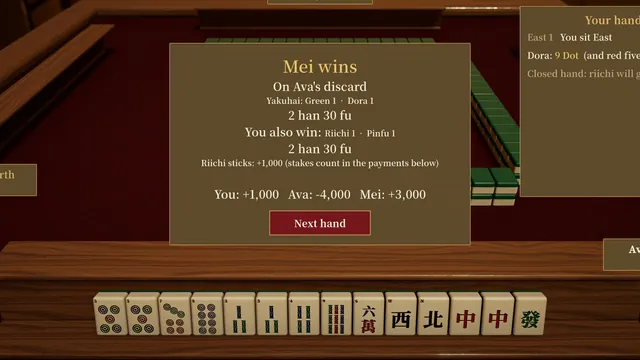
A Riichi result panel: a double win on one discard, itemised in han and fu, with riichi sticks counted in the payments.

Japanese Riichi

  • East and South rounds
  • Dora
  • Riichi
  • Furiten

Riichi with East and South rounds, dora, riichi declarations and furiten, scored in han and fu.

6 lessons
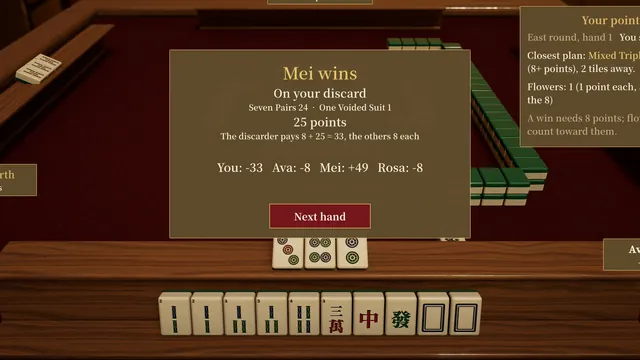
A Chinese Official result panel showing the winning patterns, their points, and what each opponent pays.

Chinese Official (MCR)

  • 81 fan
  • 8 points to win

The Chinese Official rules: 81 scoring fan, and a hand must reach 8 points to win.

6 lessons
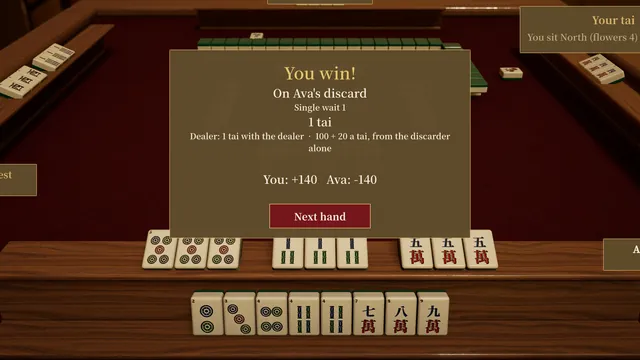
A Taiwanese result panel: a win scored in tai, with the dealer bonus, next to a rack holding three exposed sets.

Taiwanese

  • 16 tiles
  • Tai

Sixteen-tile mahjong, scored in tai.

6 lessons
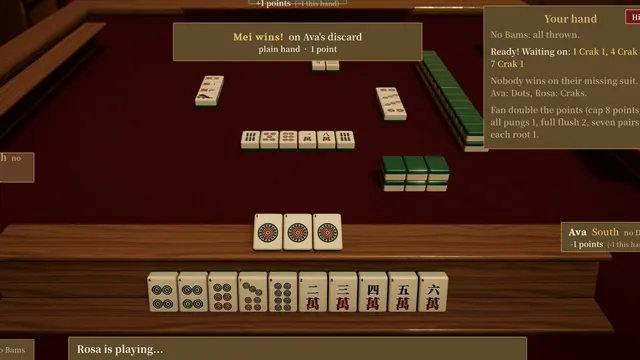
A Sichuan hand in progress: one player has already won and a banner announces it while the others keep playing.

Sichuan "Bloody Battle"

  • 108 tiles
  • Three suits
  • Play continues after wins

A 108-tile game in three suits. When someone wins, the hand does not end: the others play on.

6 lessons

Coming next

Not playable yet.

  • Singapore: the rules, computer opponents and lessons are done; the table is in progress.
  • Zung Jung
  • Western Classical
Learn by playing

A tutorial for every variant

Lessons are taught through real play at a stacked table: the game sets up the situation, asks you to make the move, and explains it. No manual to read first.

38

lessons today

  • 9American
  • 5Hong Kong
  • 6Riichi
  • 6Chinese Official
  • 6Taiwanese
  • 6Sichuan
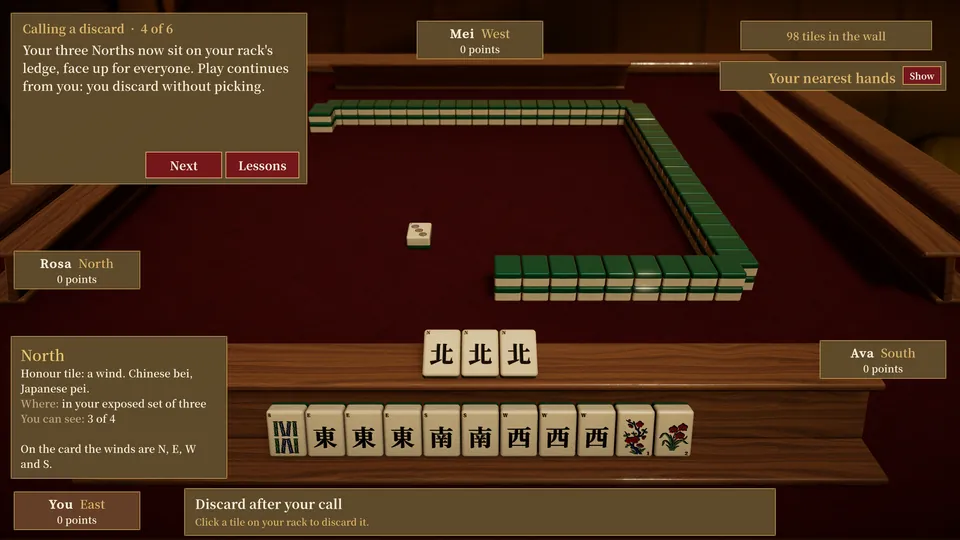
A lesson in progress: a card at the top left explains calling a discard, a note explains what a North tile is, and the player's rack holds three Norths in the exposed set.
Coming

Online play

Sit down with friends at a private table. Open seats are filled by computer players, so a table never waits. No account needed: type a name and play as a guest.
Checking the server...
  • Private tables by code. Create a table, share its code, and friends join from any device.
  • Computer players fill empty seats.
  • Google sign-in and ratings come later.
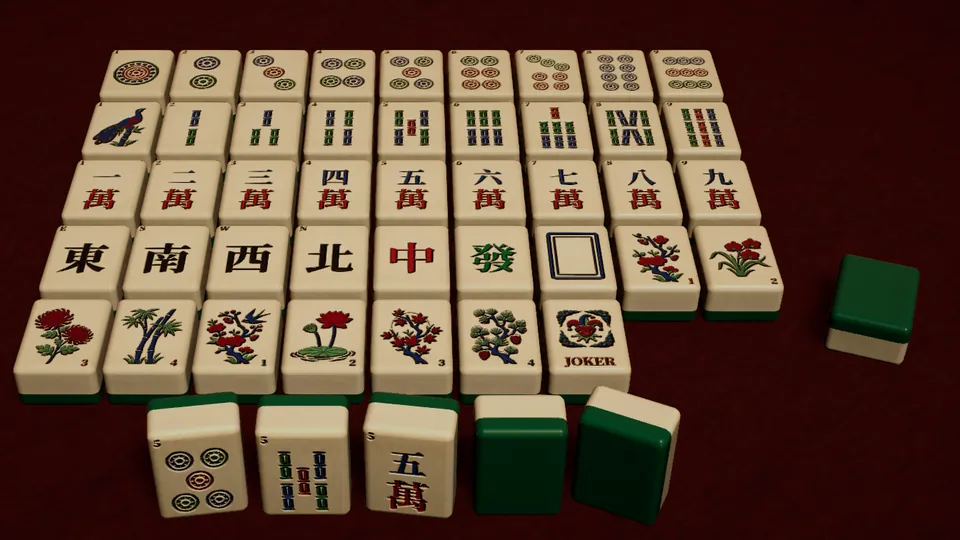
A close view of the tile set: rows of ivory tiles showing dots, bamboo, characters, winds, dragons, flowers, seasons and a joker, with a few jade-backed tiles in front.
The table

Made to look the part

A lacquered tile set on burgundy felt, inside a walnut frame, in a room with a fireplace. Every tile face is drawn procedurally, and the flower tiles are illustrated.

  • Wash, build, deal

    The tiles are washed, the walls are built and the hands are dealt in animation, with sound.

  • Three levels of opponent

    Computer players at Beginner, Standard and Expert.

  • Details on hover

    Rest the mouse on a tile, a hand or a scoring pattern and the game explains it.

  • Easy to play

    Click or tap to discard, claim and pass. Nothing to memorise.

  • Saved after every move

    Close the game any time and pick up where you left off.

  • Six variants, one table

    The same table and the same tiles for every rule set.